

Erasmus+ Spanish Teachers’ Training Lab
Erasmus+ Spanish Teachers’ Training Lab: Curso de español para profesores
July, 14-25, 2025, Malaga, Spain
Participants: I. Wiśniewska, S. Jurkiewicz
Aim: This course is aimed at teachers of Spanish as a foreign language who carry out their teaching practice outside Spain. Therefore, it is assumed that participants already possess basic methodological and didactic knowledge.
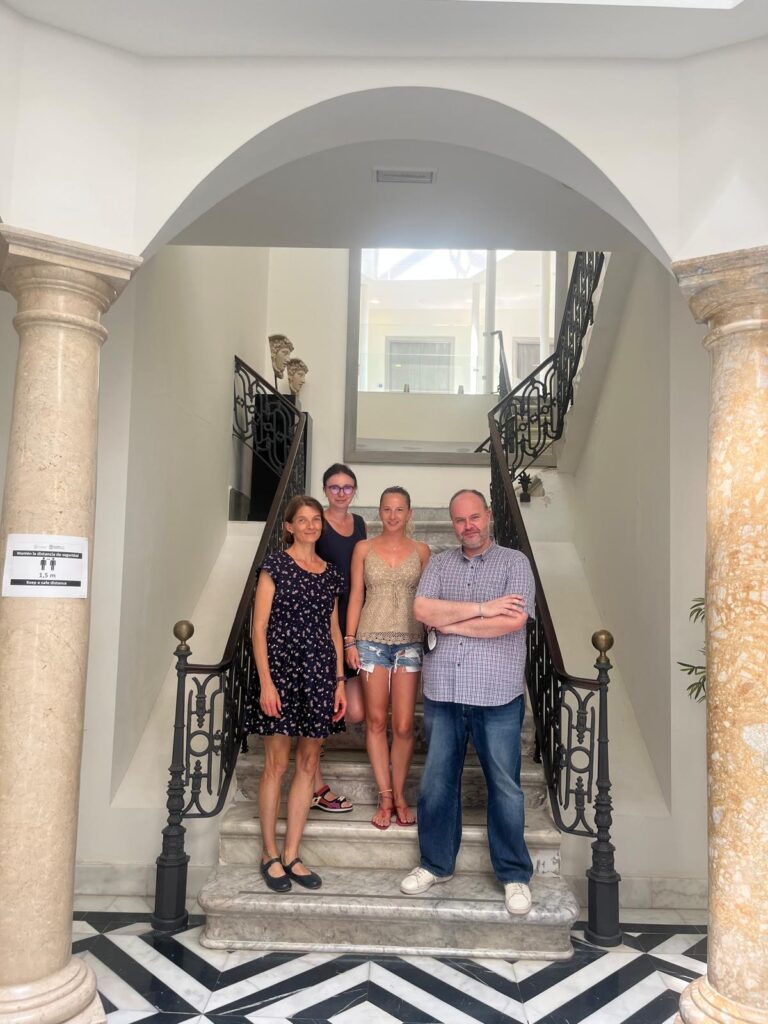
In July, we had the opportunity to take part in a two-week methodological course within the framework of the Erasmus+, which took place in sunny Malaga at the Enforex language school. The school is located in the city centre, and its modern, spacious, glass-fronted building creates an inspiring environment for learning and professional exchange.
During the course, we had the opportunity to observe classes at different proficiency levels and in various age groups, including both individual and group lessons. The observations focused on, among other things, methods of introducing new vocabulary, encouraging students to speak, and dealing with errors in foreign language teaching.
The programme was largely practice-oriented. In addition to theoretical input, we participated in workshops during which we carried out specific teaching tasks, such as:
- designing activities to develop communicative competence (e.g. creating situational dialogues in a restaurant, hotel, or airport),
- developing language games for vocabulary revision (e.g. lexical bingo, charades, board games),
- preparing short ice-breaker activities and group integration tasks,
- transforming traditional grammar exercises into communicative tasks,
- creating mini lesson plans using authentic materials.
Particularly inspiring were the “Drawing Grammar” workshops, where we creatively visualised grammatical structures, including differences in the use of tenses and sentence structures, which helped us better understand their communicative function.
A strong emphasis was also placed on integrating language skills – during classes we designed tasks combining reading, listening, and speaking, based on short videos, dialogues, or functional texts, which were then transformed into communicative classroom activities.
Afternoon cultural sessions provided an important complement to the course, combining the exploration of Spanish culture with practical tasks such as role-plays, mini cultural presentations, and city-based activities that developed language competence in authentic contexts.
The course also covered key methodological foundations of foreign language teaching, including the Common European Framework of Reference for Languages (CEFR), the methodology of grammar and vocabulary teaching, phonetics, integration of language skills, teaching children and adolescents, the use of digital tools in education, and the incorporation of games and gamification in the learning process.
Participation in the course was also an opportunity to establish professional contacts and exchange experiences with teachers from various European countries, including Hungary and Scandinavian countries, working in international education environments. Discussions focused on differences between education systems, ways of motivating students, and practical classroom solutions.